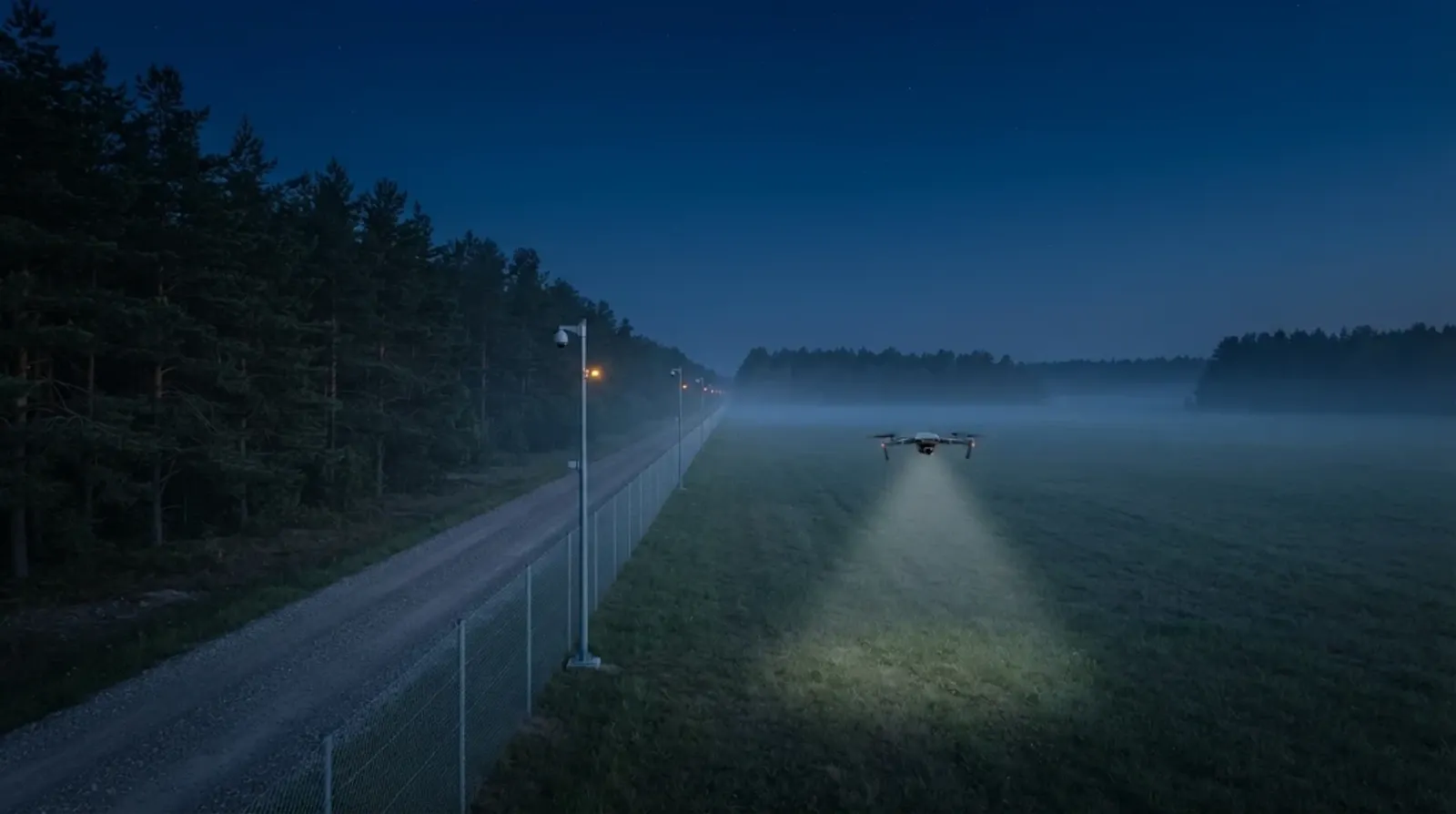
Border surveillance turns a general warning into a specific detection: this stretch of border, this night, these people. On Poland’s border with the Kaliningrad region in November 2026, intelligence services knew a provocation was being prepared. Cameras, sensors, drones and on-board AI are the tools that help officers see when and where it starts, quickly enough to act.
What happened on the Polish border
On 18 November 2026 the Polish daily Rzeczpospolita reported that Russia had prepared a sabotage operation near the border with the Kaliningrad region. According to its sources, a group was to cross the Polish border, and an attack was also to be simulated on the Russian side. The aim was to make it look as if Ukraine was responsible.
Tomasz Siemoniak, Poland’s minister-coordinator of special services, confirmed that the authorities had assessed the threat as real and taken steps. Police stations in the border districts were reinforced and special forces units were sent to the area. On the night of 2 to 3 November a group of people with flashlights was seen on the Russian side, close to the border. The operation did not go ahead.
The authorities have not disclosed the details. What is public is enough to show how such a threat is handled: an early warning, then people and equipment watching the right place at the right time.
Poland is not the only country tightening its border with Russia. On 20 November 2026 Estonia’s government decided to suspend crossings at all five road checkpoints on its Russian border from 1 December, for six months, to protect national security and public order. Prime Minister Kristen Michal said Russia’s hostile activities showed no signs of abating, and Estonian security agencies have recorded more than ten attacks. Closing a checkpoint does not close the border, though. The forest, fields and rivers between the crossings still have to be watched, day and night.
What an intelligence warning does not tell you
A warning gives an approximate time and an approximate area. A land border is long, mostly forest, fields and water, and quiet for most of the night. Patrols cannot stand on every kilometre for days.
Border surveillance closes that gap. It has to answer three questions fast:
- Is something happening? Movement, heat, sound or a cut cable at a specific point.
- What is it? People, a vehicle, a deer, a branch in the wind.
- Who needs to know? One alert with a location and a picture, sent to the operator who can send a patrol.
The faster and more reliably a system answers them, the earlier officers can respond, and the harder it is for anyone to act unseen.
What Poland already has on this border
Poland built an electronic barrier along its 199 km land border with the Kaliningrad region. The Border Guard signed the contract in December 2022, and by August 2023 almost all of the 1,932 camera poles were in place, along with detection cables and sensors. Camera and sensor signals go to a supervision centre in Kętrzyn with 12 operator stations.
The Border Guard describes its purpose as detecting border crime, above all illegal migration and smuggling, and providing continuous, automated monitoring. A provocation like the one reported in November is a different kind of threat, but it moves across the same ground and has to be seen by the same operators.
How the layers work together
No single sensor covers a border. Each layer has a job and a weakness, and a good system lets them cover for each other.
| Layer | What it does | Main limit |
|---|---|---|
| Fixed cameras, day and thermal | Watch the line around the clock, see body heat at night | Fixed field of view, fog and heavy rain |
| Detection cables and ground sensors | Report a fence being touched or crossed | Say where, not what |
| Acoustic sensors | Hear engines, aircraft and drones, including those that emit no radio | Range depends on the source and the wind |
| Drones with day and thermal cameras | Fly to the point of an alert and give a close view | Flight time, weather and airspace rules |
| On-board AI | Detects, classifies and tracks objects where the data is captured | Needs training data and testing for each site |
| Operator view | Brings tracks, video and alerts onto one map | Only as good as the alerts it receives |
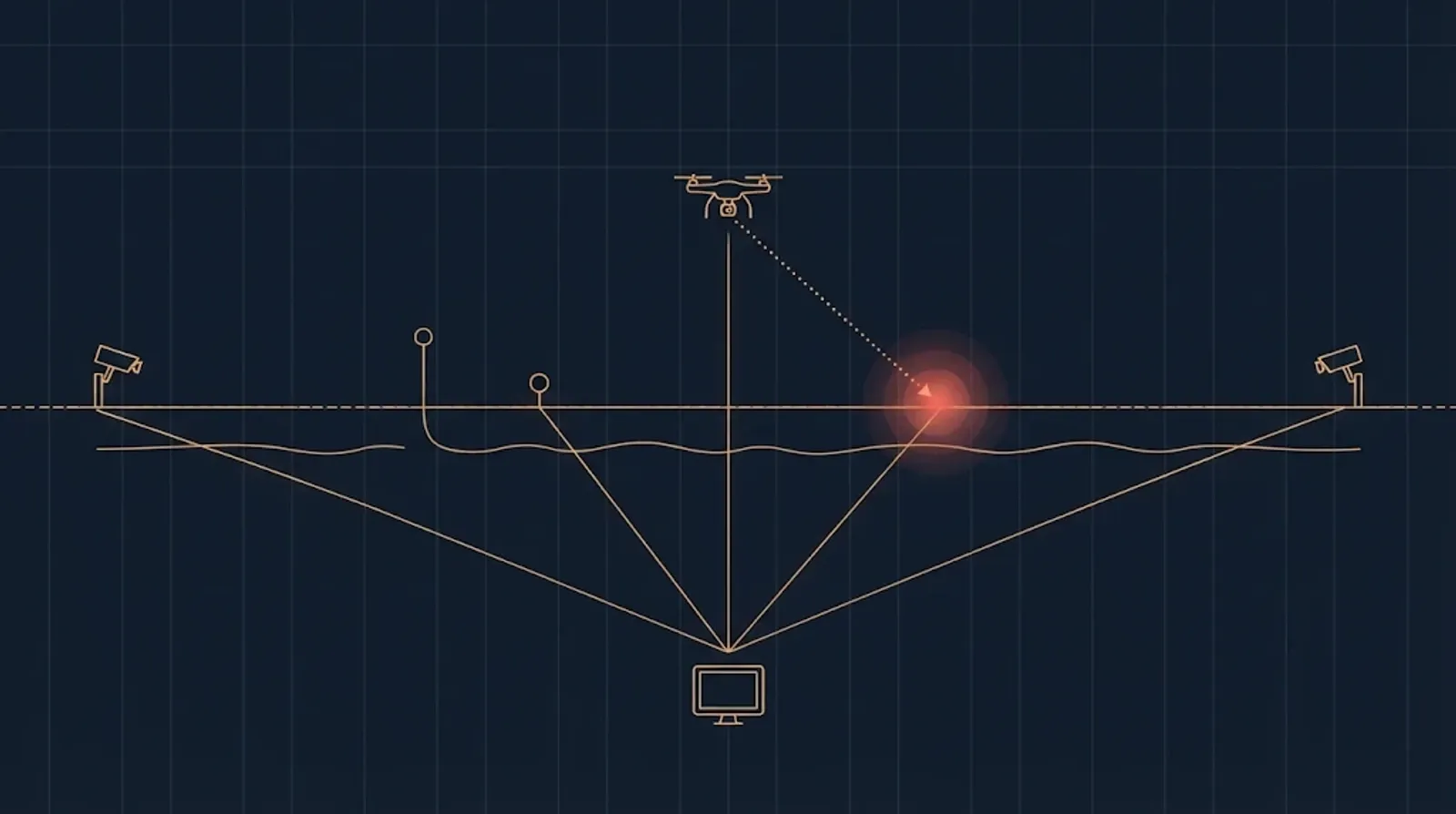
A typical night sequence looks like this: a ground sensor or thermal camera picks up movement, the system checks it against the other sensors, and a drone is sent to the location. The operator sees a live thermal image and decides whether to send a patrol.
Where AI helps, and where it does not
Most of what a border camera sees at night is nothing: animals, moving branches, rain, headlights on a road. Operators watching hundreds of feeds miss things when false alarms bury the real ones.
AI is useful at three points:
- Filtering. Telling people and vehicles apart from animals and weather, so the operator gets fewer, better alerts.
- Classifying. Saying what an object is, with a confidence score the operator can judge.
- Fusing. Combining detections from different sensors into one track and one alert, with a location.
AI does not decide what an event means or what to do about it. That stays with the officer. It also needs testing on the actual site, in the actual seasons, before anyone relies on it.
Why processing on the device and data on your own servers matter
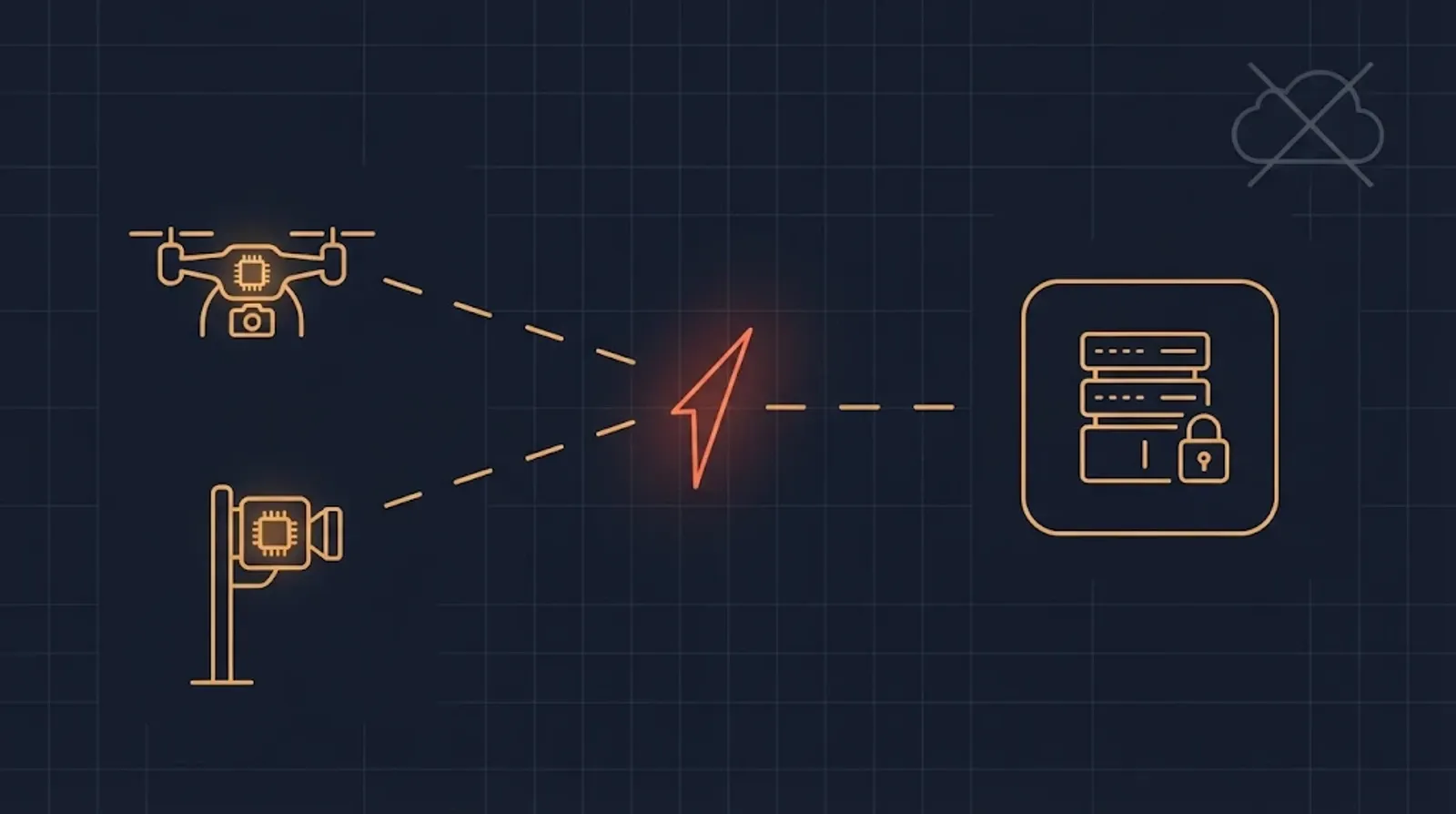
A border is exactly where links fail. Radio and satellite navigation are jammed, cables get cut, and mobile coverage is weak in forests and wetlands. A system that sends every video stream to a distant cloud for analysis goes blind when the link drops.
Two design choices keep it working:
- Processing on the device. The camera, sensor node or drone runs its own detection and sends short, structured alerts. These need little bandwidth and still get through on a weak or partly jammed link.
- Deployment on the operator’s own infrastructure. Video, alerts and recordings stay on servers the border service controls, on premises or in its own private cloud, including networks isolated from the internet. There is no dependency on a foreign cloud provider and no third party with access to the data.
Both make a system more independent and easier to secure. They also make it easier to prove what happened, because recordings and logs stay in one controlled place.
Questions to ask a supplier
- Which detections run on the device, and what still works when the link to the centre is lost?
- How many false alarms does the system produce per kilometre per night, and how was that measured on a site like ours?
- Can the whole system, including analytics and recordings, run on our servers and on an isolated network?
- How do drones receive the location of an alert, and how fast can one be over that point?
- Which behaviours were tested at night, in fog and under radio and satellite-navigation interference?
Perfsol builds the parts of such systems. Our uncrewed systems include long-range fixed-wing aircraft for perimeter patrol and multirotors with day and thermal cameras. Our onEDGE computer runs detection and tracking on board, so the aircraft keeps working when the ground link is slow, jammed or gone. Our acoustic sensor nodes are solar-powered, built for borders and remote sites, and send automated alerts with a confidence score in under 60 seconds. We deploy on the client’s own infrastructure, including isolated networks, and our engineers in Ukraine work with jamming and broken links every day.
Questions we are asked
What happened on Poland's border with Kaliningrad in November 2026?
According to Rzeczpospolita, Russia prepared a sabotage operation near the border with the Kaliningrad region, intended to look as if Ukraine was behind it. Poland's minister-coordinator of special services, Tomasz Siemoniak, said the threat was real. Police and special forces reinforced the area and the operation did not go ahead.
How do drones help with border surveillance?
Fixed cameras and sensors detect that something is happening. A drone then flies to that point and gives a closer view, often with a thermal camera at night. Operators see what they are dealing with before they send a patrol.
Can AI replace border guards?
No. AI filters and classifies what the sensors pick up and alerts an operator. Officers decide what it means and what to do, and they are the ones who respond on the ground.
Sources
- Rosja planowała prowokację na polskiej granicy. Siemoniak: „Było realne zagrożenie” (18 November 2026), Defence24
- Prowokacja pod fałszywą flagą. Polskie służby udaremniły rosyjską operację (18 November 2026), OKO.press
- Russia planned a false flag attack on the Polish border (19 November 2026), Babel
- Estonia to close land border with Russia from December 1 (20 November 2026), ERR News
- Bariera na granicy z obwodem kaliningradzkim (9 December 2022), Polish Border Guard
- Zakończono jeden z etapów bariery elektronicznej na granicy polsko-rosyjskiej (10 August 2023), Polish Border Guard