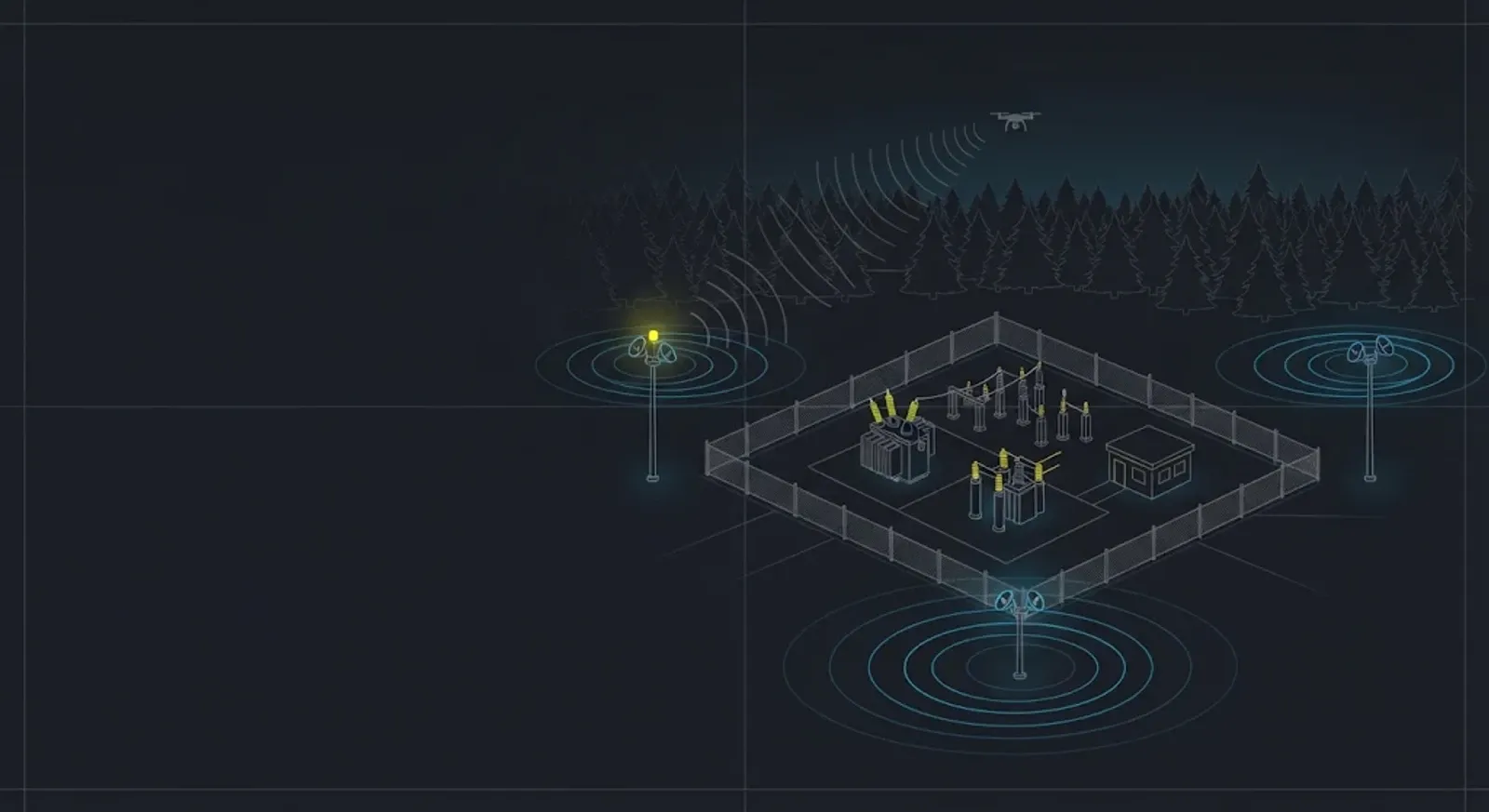
Acoustic drone detection is a way to find drones by the noise they make. Microphones on a sensor node pick up the sound of engines and propellers, an AI model on the node recognises it, and the node sends an alert. The nodes we deploy, built by our hardware supplier, are specified to hear combustion-engine drones at up to 3 km and electric ones at up to about 200 m, including drones that fly with their radio off.
This guide covers how the method works, the physics that sets its range, how well the AI really classifies, what Ukraine’s national sensor network shows, and how to deploy and test a network on your own site.
How acoustic drone detection works
Every drone makes noise. Propellers produce a tone at the blade-pass frequency, the rate at which blades pass a fixed point, and the motor adds its own harmonics. A combustion engine is louder and lower than an electric motor, and each type of aircraft or boat has a recognisable pattern, sometimes called its acoustic signature.
A detection chain has four parts:
- Sensor node. Microphones, sometimes with acoustic reflectors that concentrate sound from one direction, record the sound field. The nodes we deploy cover 40 Hz to 5 kHz, the band where engines and propellers are loud, and sample at up to 44.1 kHz.
- AI on the node. A model running on the node compares what it hears with known signatures and separates drones from wind, traffic and machinery. The node sends a structured detection instead of raw audio. A data link of at least 32 kbit/s is enough.
- Central processing. A server, on the client’s premises or in the cloud, combines detections from many nodes, works out where the object is and keeps a track as it moves.
- Alert. The operator, or another system, receives which sensor heard it, what type of object it is, an estimated range and a confidence score.
The supplier trained the models in these nodes on real recordings from a sensor network it runs in Ukraine, where drones of many types are heard every day.
What a drone sounds like, and why the sound fades
The loudest part of a multirotor’s noise comes from the rotating blades at the blade-pass frequency, with tonal noise beneath it. A 2022 study in the Journal of the Acoustical Society of America, summarised by AIP, also found that the direction in which a drone radiates sound changes considerably with propeller speed. The same drone can sound different from one side than from another, and different again as its propellers speed up.
On the way to the microphone, the sound gets weaker for three reasons:
- Distance. In open air, the level drops by about 6 dB each time the distance doubles. A drone heard clearly at 100 m is about 12 dB quieter at 400 m, before anything else gets in the way.
- The air itself. Air absorbs high frequencies far more than low ones: about 0.25 dB per 100 m at 2 kHz in typical conditions, and up to 5 dB per 100 m at 8 kHz in dry air. At long range, the higher tones fade first and the low tones of engines and propellers dominate. That is one reason detection nodes listen below about 5 kHz.
- Ground and weather. Thick grass can absorb up to about 10 dB per 100 m at 2 kHz. Wind bends sound upwards when it travels against the wind and downwards when it travels with it, and the difference between the two can reach 20 dB. On a calm night with a temperature inversion, sound bends back towards the ground and carries further.
In practice, the same node on the same pole hears further downwind than upwind, and further on a still night than on a windy afternoon. A datasheet range assumes good conditions. The real range on your site changes with wind and temperature over the day.
How the AI tells a drone from a lawnmower
Typical classifiers turn a second or so of sound into a spectrogram, a picture of how loud each frequency is over time, and a neural network classifies that picture. Propeller tones show up as bright horizontal lines that move together when the drone speeds up or slows down. A lawnmower, a generator or a car has a different pattern.
Published accuracy figures need careful reading:
- In the lab. A 2021 study in Sensors reported 96.4% detection accuracy for a convolutional neural network on one-second clips. The clips were recorded indoors, 1 to 20 m from the drone, with noise added afterwards. On a drone model the network had not seen in training, its recall for that model fell to 0.19.
- In the field. A 2022 study with a small four-microphone array outdoors detected drones at about 65 m in urban areas and 77 m in rural ones. It reported an average confidence of 84% for drone or no drone and 78.8% for telling drone types apart. In cities, echoes off tall buildings made false alarms harder to avoid.
A model is as good as the recordings it learned from: real drones, at real distances, against real background noise. When a supplier quotes an accuracy figure, ask at what distance it was measured, in what background, on which drone types, and with what false-alarm rate.
Detection nodes and direction-finding arrays
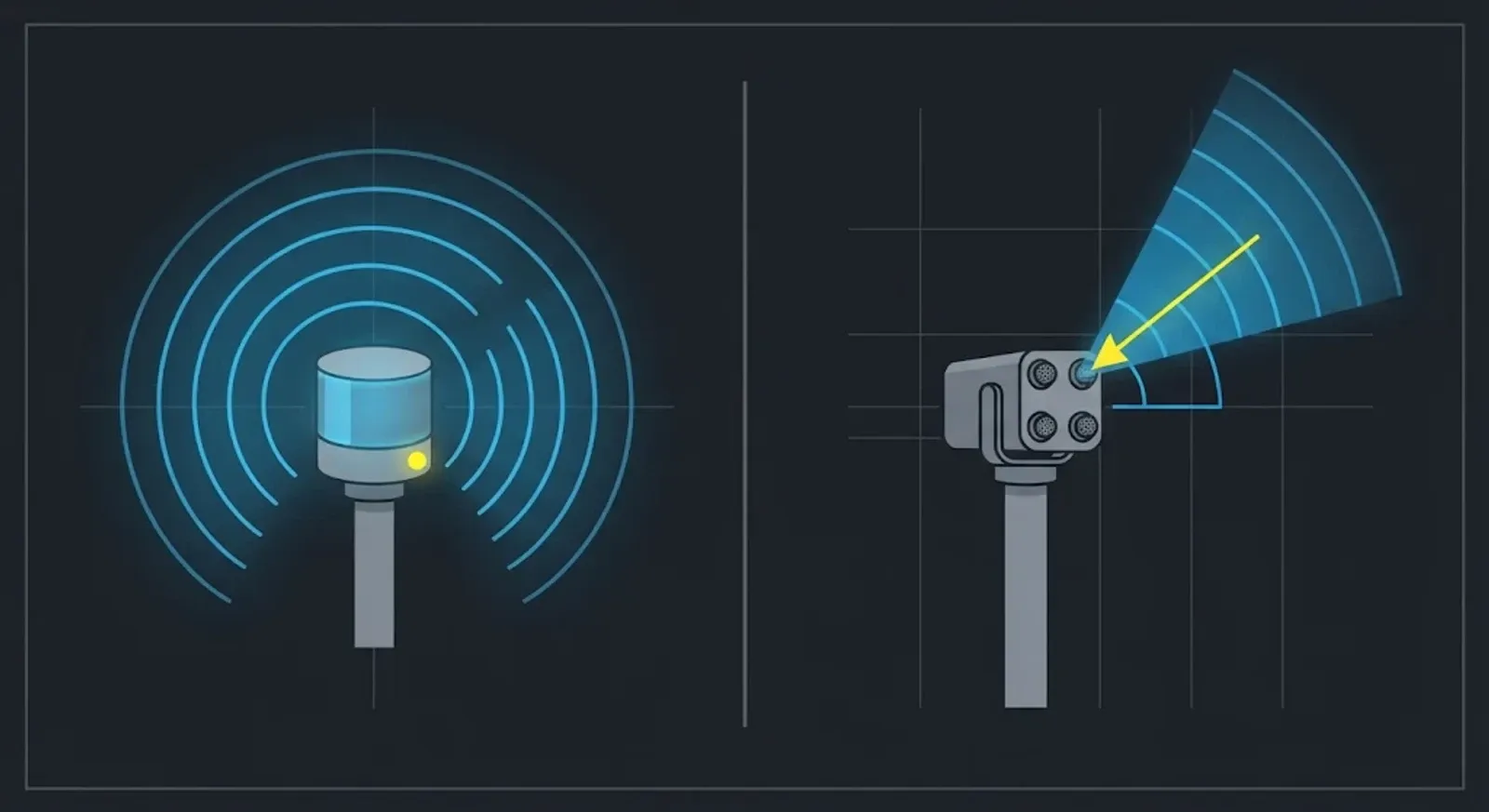
Not every acoustic sensor does the same job. In practice there are two kinds of node, and they work together.
| Detection node | Direction-finding array | |
|---|---|---|
| Job | Early warning that a drone is close | Direction and tracking |
| Microphones | Compact node, hears all around (360°) | Four-microphone array |
| Typical range | Electric drones up to about 200 m | Combustion-engine drones up to 3 km, electric up to about 150 m |
| Output | Detection alert | Bearing in azimuth and elevation |
| Position | No | Yes, with two or more arrays |
A detection node answers one question: is there a drone near this point? It is small and can be mounted on a building or a pole. It suits perimeters and rooftops, where a warning is enough.
A direction-finding array uses four microphones to estimate where the sound comes from, both horizontally and vertically. Sound reaches each microphone at a slightly different time, and the array works the direction out from those differences. When two or more arrays hear the same drone, central processing triangulates its position and from consecutive positions estimates its course, speed and approximate altitude. An optional camera on the array confirms visually what was heard. Our acoustic detection grid combines both kinds.
Geometry decides how good the position is. In the 2022 field study, the measured direction fluctuated by about ±5°. As an illustration, a ±5° bearing error at 1 km is about ±87 m to the side. Two arrays whose bearings cross at a wide angle give a tighter position than two arrays that see the drone from almost the same direction. That is why array placement is a design task in its own right.
Acoustic drone detection range
Range is set mainly by how loud the object is. These are the supplier’s figures for the nodes we deploy:
| Object | Typical detection range |
|---|---|
| Drones and uncrewed boats with combustion engines | up to 3 km |
| Propeller aircraft | up to 3 km |
| Drones and uncrewed boats with electric motors | up to about 200 m |
These are upper bounds in good conditions. Strong wind, a busy road, an industrial site or a building between the node and the drone all shorten them. The US Cybersecurity and Infrastructure Security Agency (CISA) puts it plainly in its 2025 guidance: acoustic sensors have a shorter detection range than other sensor types, ambient noise and extreme weather reduce detection range, and terrain and structures reduce location accuracy. This is why acoustic nodes are deployed in networks.
The supplier’s datasheet lists a response time of 12 seconds. Near a node, a fast small drone can cover the whole detection range in that time. For fast drones, early warning comes from radar, as we explained in counter-drone lessons from Ukraine.
Ukraine’s acoustic network at national scale
Ukraine shows what acoustic detection looks like when it covers a country. In July 2024, US Air Force General James Hecker told reporters that Ukraine had about 9,500 acoustic sensors, each costing about $400–500, as Defense One reported. Reports in February of the same year put the number at about 6,000. The War Zone estimated from his figures that the whole network cost less than $5 million.
The early nodes were simple: a microphone and a mobile phone on a pole about two metres high. According to the 2024 reports, detections from thousands of nodes were fused on a central computer into tracks.
For a European site, the lesson is the architecture. Many cheap nodes, a low-bandwidth link and strong central fusion cover an area that a few expensive sensors cannot. The nodes we deploy for clients are not part of that network. They take a similar approach, many nodes on a low-bandwidth link of 32 kbit/s, but classify on each node before central fusion.
Advantages of acoustic drone detection
- Passive sensing. Listening emits nothing and cannot be jammed. Only a low-rate data link transmits, so a node has a low radio signature.
- Independent of the drone’s radio. It hears pre-programmed drones and fibre-optic drones that RF detection misses.
- Works in poor visibility. Darkness, fog and rain do not blind a microphone.
- Cost-efficient coverage. Small nodes are cheap enough to cover a large area densely, as Ukraine’s network, built from much simpler nodes, shows.
- Hears the water as well. Floating nodes detect surface vessels and uncrewed boats along a coast.
Limitations of acoustic drone detection
- Background noise and wind. Next to a motorway, a plant or in a storm, the useful range shrinks. Separating drone sound from background noise is the main challenge for every acoustic system.
- Weather changes the range. Wind direction alone can change what a node hears by up to 20 dB, and temperature layers add to it. Coverage maps drawn for calm weather overstate coverage on windy days.
- Quiet and fast drones. They leave less time between first detection and arrival. Radar and cameras cover them.
- Position needs geometry. A single node gives presence or direction. Position needs at least two arrays with overlapping coverage, placed at a good angle to each other.
- Every site sounds different. Detection thresholds need tuning to the local background to keep false alarms low, and a model trained elsewhere needs checking against local sounds.
That is why acoustic sensors work best as one layer. Radar measures range and speed, cameras confirm what the object is, and acoustic nodes close the gaps both leave. CISA recommends this layered approach, built into the site’s existing security plans, and the European Commission’s Joint Research Centre stresses multi-sensor data fusion for detection, tracking and identification in real time. Fusing detections into one track with one classification keeps false alarms low enough for a security team to trust the system.
Three ways to deploy an acoustic network
The site sets the design. Three typical cases cover most projects.
A site with power and data. An energy site, a plant or a logistics hub usually has mains power, wired networks and masts or roofs to mount on. Nodes run on Power over Ethernet at 48–53 V and send detections over the existing network. Central processing can sit in the client’s own server room.
A remote area without power or roads. Borders, pipelines and wilderness areas often have no grid, weak mobile coverage and visits once a week. Here each node carries a 200 W solar panel, a charge controller and a battery of up to 64 Ah, and sends detections over LTE or a mesh between nodes. The hardware is sealed to IP68 for electronics and IP57 for microphones, works from −30 °C to +40 °C and weighs 2.5 kg with mounting. Where winters are colder than that, check the temperature range against local conditions first.
A coast or archipelago. Existing buildings and masts take watchtower nodes with reflectors for long-range listening. Floating buoys extend the network over water, where they also hear boats. For this solar-powered grid of towers and buoys, the supplier’s design targets are network availability above 95%, an alert from the network in less than 60 seconds and more than 10 days of operation without sunlight.
In all three cases, the network sends alerts into the systems the client already uses: video management, alarm panels or a situational-awareness platform.
How to test an acoustic system before you rely on it
A datasheet and a demo day do not tell you how a system behaves on your site in February. Counter-drone systems are tested in the open for this reason: NATO’s technical interoperability exercise in the Netherlands in September 2023 tested about 70 systems and technologies live, sensors among them. A site needs its own, smaller version of that test.
A useful acceptance test covers:
- Your background. Record the site’s sound for at least a few days, across shifts, traffic peaks and weather, before thresholds are set.
- Real flights. Have a licensed operator with the necessary airspace permissions fly test drones of the types that worry you, from several directions and at several distances, with the drone’s own position logged for comparison.
- Different conditions. Repeat flights upwind and downwind, by day and at night, and in the wind your site usually has.
- The right measurements. Record the share of flights detected, the distance at first detection, the bearing and position error against the drone’s log, the time to alert and the number of false alarms per day.
- The full chain. Check that the alert reaches the operator’s own tools with the right information.
The result is a coverage map you can trust, and a list of the gaps that radar, cameras or more nodes have to close.
How Perfsol helps you implement it
We do the work around the sensors:
- Site survey and acoustic baseline. We look at the area, terrain and neighbouring systems, and measure the acoustic environment. The design then starts from how the site really sounds.
- Network design. Node types and positions, array geometry for triangulation, mounting points, power and communications for each node, and where central processing runs.
- Integration. Alerts and tracks into your video management, alarm and security platforms, and fusion with radar and cameras when the site has them. Our counter-drone solution covers the full set.
- Installation and acceptance. Installation, tuning of thresholds to the site and the acceptance test described above. You know what the system detects before you rely on it.
- Training and support. Operator training, monitoring of node health, maintenance, and model updates from the sensor supplier as the drones change.
We build and test our own systems in Ukraine under power cuts, broken links and bad weather.
Where to start
Write down four things: what you need to protect, how large the area is, what power and data are available at its edges, and what has been seen or heard in the air so far. Send us those answers through the contact form. We will propose a site assessment and tell you whether acoustic detection alone, or as one layer with radar and cameras, fits your site.
Questions we are asked
Can acoustic sensors detect a drone that does not transmit any radio signal?
Yes. An acoustic node listens for the sound of the motor and propellers, so it does not depend on the drone's control or video link. That is the main reason to add acoustic sensors to a site that already has RF detection.
How far away can an acoustic sensor hear a drone?
It depends mostly on the propulsion. The nodes we deploy are specified to detect drones and uncrewed boats with combustion engines at up to 3 km and electric ones at up to about 200 m. Wind, terrain and background noise shorten these distances.
How accurate is acoustic drone classification?
Published results range widely. One study reached about 96% on short recordings made indoors at up to 20 m, and accuracy fell sharply on drone models the network had not been trained on. A field study with a four-microphone array reported an average confidence of 84% for drone or no drone. Ask how any accuracy figure was measured.
How many acoustic sensors does a site need?
It depends on the area, the terrain and what you need to know. Detection alone can start with a few nodes around the perimeter. To get a position, course and speed, at least two direction-finding arrays must hear the same drone, so they are placed with overlapping coverage.
Does acoustic detection replace radar?
No. Radar measures range and movement in any light and weather and gives the earliest warning for fast drones. Acoustic nodes are good at hearing what radar or RF sensors miss. Together they usually give fewer false alarms than either alone.
Sources
- What is an acoustic drone detection system? (8 September 2025), Defense Systems Information Analysis Center (DSIAC)
- Unmanned Aircraft System Detection Technology Guidance (October 2025), US Cybersecurity and Infrastructure Security Agency (CISA)
- Sound Propagation, Handbook for Acoustic Ecology, Simon Fraser University, World Soundscape Project
- The droning of the drones (11 November 2022), AIP Scilight
- Audio-based drone detection and identification using deep learning techniques with dataset enhancement through generative adversarial networks (Sensors, 2021), Al-Emadi, Al-Ali and Al-Ali, Sensors 21(15)
- Small UAS online audio DOA estimation and real-time identification using machine learning (Sensors, 2022), Kyritsis, Makri and Uzunoglu, Sensors 22(22)
- Ukraine's cheap sensors are helping troops fight waves of Russian drones (20 July 2024), Defense One
- Ukraine's acoustic drone detection network eyed by U.S. as low-cost air defense option (24 July 2024), The War Zone
- NATO counter-drone technical interoperability exercise (22 September 2023), NATO
- Counter-drone systems and data fusion (4 December 2024), European Commission, Joint Research Centre
- Counter-drone and drone detection systems, Perfsol
- Counter-drone lessons from Ukraine for Europe, Perfsol