
In July 2026 Reuters reported drones reaching high-voltage substations in Ukraine past nets, concrete shelters and jamming. They were fibre-optic drones (fiber optic in American spelling), flown through a thin glass fibre that unwinds behind them. With no radio link, there is nothing to jam and nothing for an RF detector to hear. Ukraine’s Ministry of Defence says 374,000 of them were delivered to its own forces in 2025. For a European energy site, port or plant, detection of such a drone has to come from radar, sound and cameras.
How a fibre-optic drone works
Most fibre-optic drones are small first-person-view (FPV) drones. A normal FPV drone receives commands from its pilot and sends video back over radio. A fibre-optic drone carries a spool of thin, translucent optical fibre. One end stays with the operator. As the drone flies, the fibre pays out behind it, and commands and video travel through the glass.
For a defender, the fibre changes three things:
- No radio emissions. As Noah Sylvia of RUSI explained in 2024, the drone sends no radio signal that could reveal its position or its operator’s.
- No effect from jamming. As long as the fibre is not cut or snagged, interference does not reach the link, Reuters reported in 2026.
- Clean video. Sylvia also noted that the pilot keeps a clear picture despite interference.
Wired links are not new in civil work. Tethered drones that exchange data through a cable inspect power lines, pipelines and telecom towers, and tether maker Elistair cites secure data and minimal jamming risk as the reasons.
Why jamming and RF detection do not work
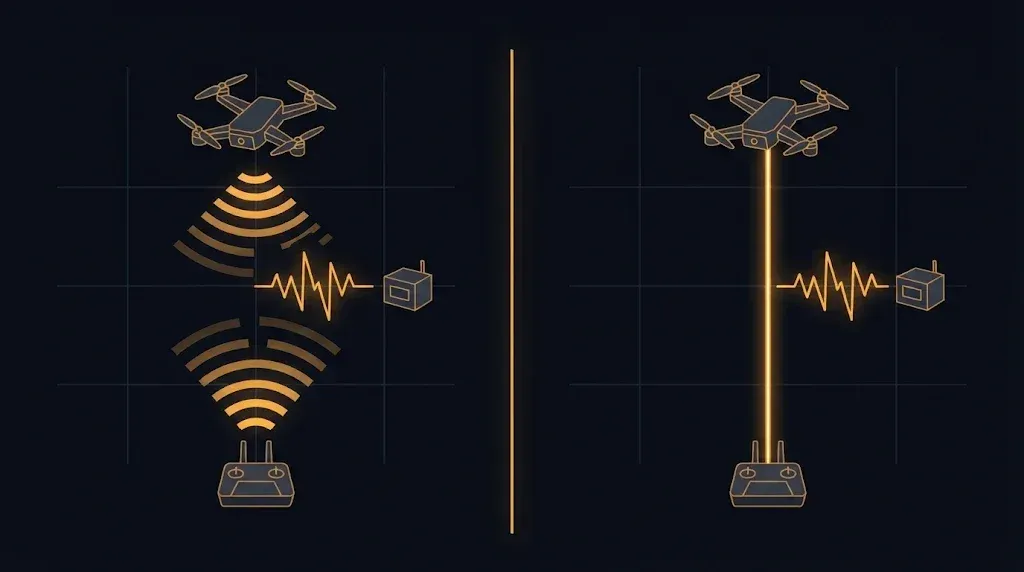
Most counter-drone set-ups at civil sites start with radio. RF detectors listen for a drone’s control and video links, identify the model and sometimes locate the pilot. Jammers break those links, where the law allows them and only in the hands of authorised operators.
Against a fibre-optic drone both tools have nothing to work with. There is no link to hear and none to break. A site whose only sensor is an RF detector would get no warning until a person saw or heard the drone.
How far can a fibre-optic drone fly, and its other limits
The fibre is not free. Public reporting from Ukraine describes the same trade-offs again and again:
- Reach. Cable length usually limits these drones to about 10–25 km, Business Insider reported. Variants with about 50 km of fibre have appeared.
- Weight. The spool can weigh several kilograms. The drone needs a bigger frame and carries less.
- Speed and agility. Fibre-optic drones are slower and less manoeuvrable than similar radio-controlled ones.
- Fragility. The fibre can snap, or be cut or snagged.
- Noise. They are louder than similar drones without a cable, according to Euromaidan Press.
- A trace on the ground. Spent fibre stays on the ground after the flight. It is often visible only in direct sunlight or from certain angles.

Several of these limits help a defender. A slower, louder drone gives an acoustic or radar layer more time.
Who uses fibre-optic drones
Ukraine’s Ministry of Defence reported in April 2026 that 374,000 fibre-optic drones were delivered under its procurement contracts in 2025. Russia uses them too, including against substations, as Reuters reported.
Ukraine has invested heavily in passive protection. Defence minister Mykhailo Fedorov said in June 2026 that Ukraine had built 822 km of anti-drone protection along frontline roads, including nets and mesh canopies. At substations, high-voltage transformers sit under concrete “sarcophagi”. The July report showed the limit of that approach: Reuters verified at least eight cases of drones reaching 330 kV and 110 kV substations 16–26 km from the front, past both nets and shelters. Each drone was said to cost about $2,000.
How to detect a fibre-optic drone
Because the drone does not transmit, detection depends on sensors that see, hear or measure the aircraft itself.
| Sensor | Sees a fibre-optic drone? | Strengths | Limits |
|---|---|---|---|
| RF detector | No | Identifies radio-controlled drones and can locate the pilot | Nothing to detect |
| Radar | Yes | Range and speed in any light and weather | Small, slow, low drones are hard to separate from birds and clutter |
| Acoustic sensors | Yes | Passive, cheap to spread out, hears drones that emit no radio | Short range for electric drones, sensitive to wind and background noise |
| Thermal and optical cameras with AI | Yes | Confirm what the object is, see motor heat at night | Need a line of sight and a cue where to look |
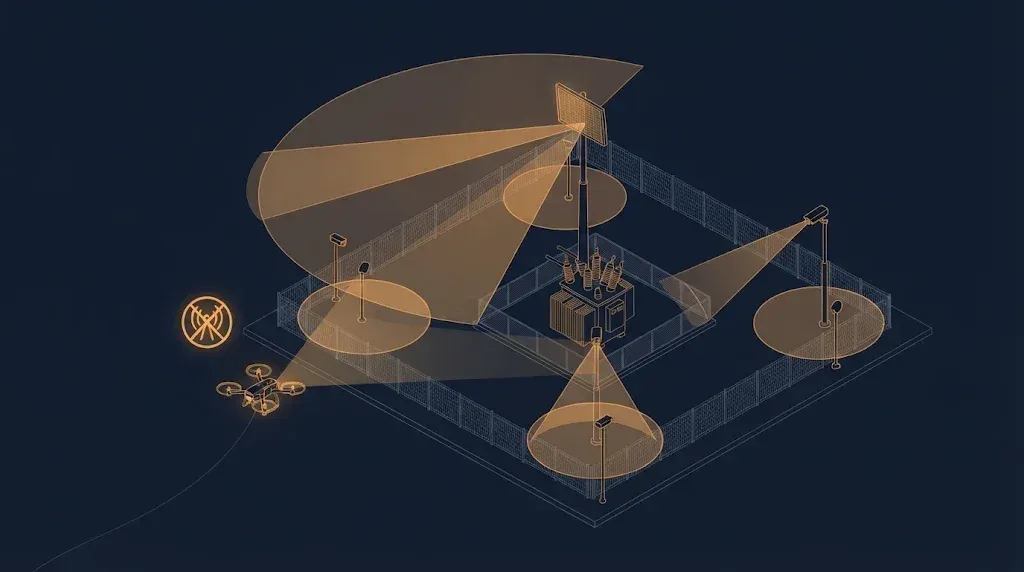
Radar sees the airframe and gives range, speed and direction in any weather. How early it warns depends on the class of radar chosen for the site, from compact short-range modules to long-range systems. Its weakness is the target: small, slow and low, the same profile as a bird.
Acoustic sensors are a promising fit. A fibre-optic drone is louder than a similar radio-controlled one and has no radio to hide or reveal. Range is the limit: reporting from Ukraine describes acoustic detection of these drones as difficult beyond about 100 m. The nodes we deploy hear electric drones at up to about 200 m in good conditions, according to the supplier’s datasheet. Acoustic nodes therefore belong close to what they protect, as a dense inner layer. We explain the method in acoustic drone detection.
Thermal and optical cameras with on-board AI confirm what an object is and see motor heat in the dark. Proposals from Ukraine include spotting light reflected off the fibre. Cameras need a cue from radar or acoustic sensors to know where to look.
Fusion ties the layers together. Radar gives the first track, acoustic nodes confirm a drone close in, a camera shows what it is, and the security team gets one alert with a track and an image. This is how our layered counter-drone detection works, and we can assess which of these layers your site needs.

Are fibre-optic drones a threat in Europe?
No confirmed use of a fibre-optic drone against a European site had been reported by November 2026. Defence organisations are already looking for detection methods:
- NATO, Tallinn, June 2025. A NATO innovation challenge on countering fibre-optic drones was held in Tallinn, with Estonia as a sponsor. It drew 162 proposals and asked for detection by day and night at a range of at least 500 m. A Ukrainian company, DONS, was among the winners.
- United Kingdom, March 2026. UK Defence Innovation asked industry for ways to detect, track and identify fibre-optically controlled drones, for fixed sites as well as mobile users.
European airports have already closed over drone sightings that nobody could confirm, as we described in counter-drone lessons from Ukraine. Sensors that detect drones without radio can be specified, tested and installed before they are needed.
What a critical site can do now
- Check what your sensors depend on. If your detection is RF only, a fibre-optic drone is invisible to you. List which sensors would see an aircraft that does not transmit.
- Cover the low approaches. Fibre-optic drones are slower than radio-controlled ones. Plan for low approaches, look at the directions where trees, buildings and terrain would hide a drone from radar, and place acoustic nodes and cameras there.
- Protect the critical equipment physically. Nets and shelters around transformers and control buildings buy time. Reuters’ reporting from Ukraine shows they are not enough on their own.
- Plan the response. Decide who receives an alert, what they check and what they do in the minutes after it arrives.
- Test. Fly authorised test drones on your site, with a licensed operator, and see what your sensors report.
How Perfsol helps
Our counter-drone solution detects drones whether or not they transmit. Its detection layers, acoustic nodes, cameras with AI and radar, do not depend on the drone’s radio. Radar modules come from our partner Tyko Tech. The system fuses the layers and sends one alert per drone to the video management and alarm platforms the site already uses. RF mitigation is regulated, and we supply it only to operators authorised under their country’s radio, aviation and export-control rules.
Security integrators can add our acoustic and camera layers to systems they already run.
A project starts with a site survey: what flies near you, which approaches your current sensors miss, and which layers close those gaps. It ends with an acceptance test using authorised test flights, and records what each sensor saw on each flight. We build and test our own systems in Ukraine, under power cuts, network loss and jamming.
Where to start
Take a map of your site and mark the three approaches a low, slow drone would most likely use. Then mark which of your sensors would detect a drone that sends no radio signal on each of them. If any approach has no sensor, tell us about the site: what it protects, its size and which sensors you run today. We will propose a site survey and agree a secure channel before any site plans change hands.
Questions we are asked
What is a fibre-optic drone?
A drone, usually a small first-person-view (FPV) drone, whose control commands and video travel through a thin optical fibre that unwinds from a spool as it flies, instead of over a radio link.
How far can a fibre-optic drone fly?
As far as its fibre reaches. Reported lengths are usually 10 to 25 km, and variants with about 50 km of fibre have appeared. The spool adds several kilograms, which makes the drone slower and less agile.
Can fibre-optic drones be jammed?
No, not while the fibre is intact. There is no radio link to jam. A jammer can still affect other radios on board, but the control and video link runs through glass.
Why can't RF detectors see a fibre-optic drone?
RF detectors listen for the radio signals between a drone and its pilot. A fibre-optic drone sends its commands and video through the fibre, so it emits no control or video signal for a detector to hear.
How can you detect a fibre-optic drone?
With sensors that do not depend on the drone's radio. Radar sees the aircraft itself, acoustic sensors hear its motors and propellers, and thermal and optical cameras with AI see its heat and shape. Combining them gives the most reliable picture.
Are fibre-optic drones a threat outside Ukraine?
No confirmed use against a European site had been reported by November 2026. NATO ran an innovation challenge on detecting them in Tallinn in 2025, and the UK asked industry for detection solutions in 2026.
Sources
- Russia evades Ukraine electrical substation defences with small, unjammable drones (Reuters, 10 July 2026), Reuters via The Star
- Purchasing mechanism for fibre-optic drones updated (21 April 2026), Ministry of Defence of Ukraine
- Ukraine war: How and why Russia is using 'almost indetectable' drones (1 September 2024), RUSI (Euronews interview)
- Russia's fiber-optic drones dodge jamming, but Ukraine hunts them with infrared and sound (3 February 2025), Euromaidan Press
- Unjammable drones are leaving wires everywhere, forcing Ukrainian troops to move with caution (December 2025), Business Insider via Yahoo News
- Ukraine has built 822 kilometers of anti-drone road tunnels (6 June 2026), Euromaidan Press
- Countering fiber-optic controlled FPV drones: Ukrainian company among the winners of JATEC's hackathon (20 June 2025), Ministry of Defence of Ukraine
- NATO innovation challenge in Tallinn (June 2025), Kyiv Post
- UKDI seeks innovations to detect and defeat fibre optically controlled UAS (27 March 2026), GOV.UK, UK Defence Innovation
- Drone tether: unlimited flight and secure data transmission, Elistair